

Summer Snow Experience
- Leah Erickson
- Jun 18, 2025
- 3 min read
The first two weeks of June at Snow College is Summer Snow. It is an intensive two weeks of art classes. They have been holding this annual event for fifty years. I have been lucky enough to have attended for 2 years. I first found out about it when I was a student at Snow studying art.

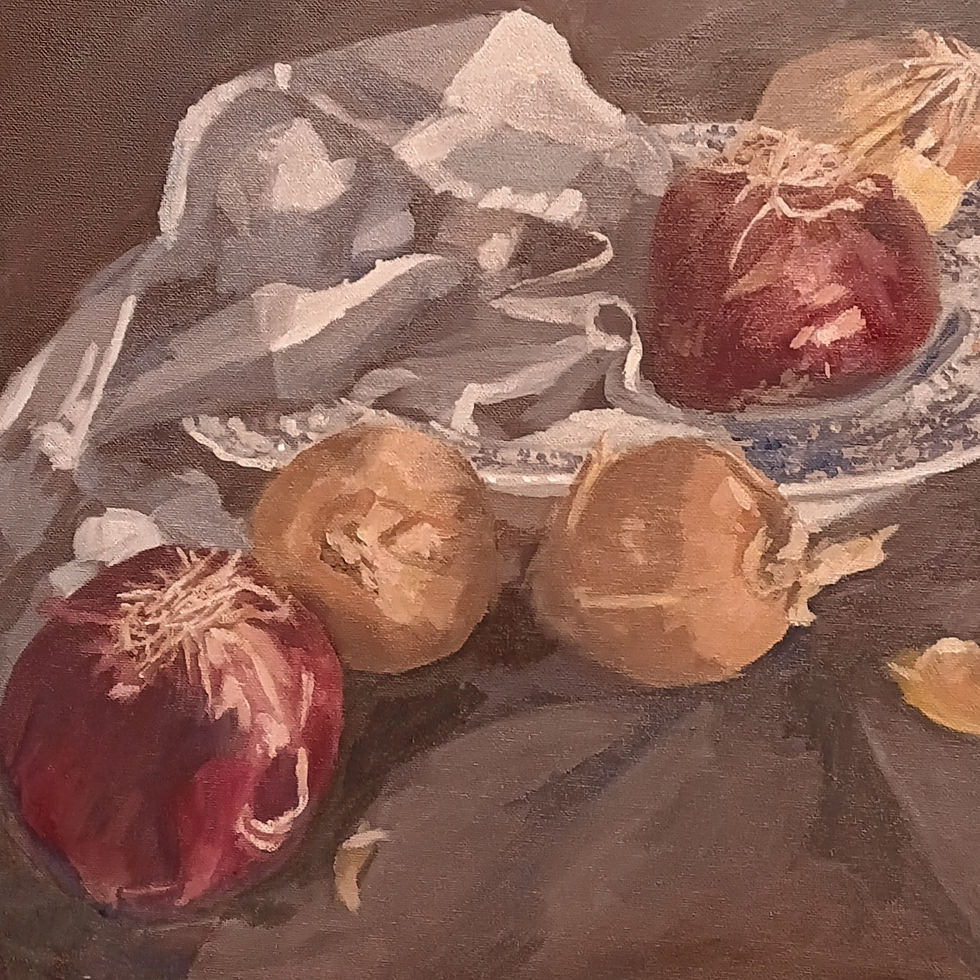
This year I went for both weeks. I stayed in the college dorms, close enough to walk to classes each day. The first week I did still life in oil paints. I haven't worked in oil paints for a long while and have felt a little intimidated by them. They seemed a bit complicated compared to watercolor paint. Oil paints need special solutions to use them; they could be toxic and take a long time to dry. But I was mistaken. I brought six tubes of paint with me and some Gamosol, an odorless solvent that cleans and dilutes the paints. A palette to hold the paints and a few brushes, mostly small flat brushes. All simple and straight forward.
The subject I brought with me was onions, and I also brought a jar, a pretty antique bowl, and a blue plaid cloth. I only had yellow onions and at the end of the first day I purchased two large purple onions. I arranged still life settings and painted all week. The way the oils went down, smooth, creamy and blending so well. Overnight the paint dried pretty well, I only used thin layers of color. I was so happy and fell in love with painting with oil paint and have plans to continue working with oil paint. I am hoping to take a portrait painting class in the fall with the same teacher, Ron Richman.
The second week I was joined by my daughter, an artist practicing in Lago Vista Texas, which is near Austin. She took the metal casting class, working with Brad Taggart, pouring and molding aluminum and a little bit of bronze. I worked with K Stevenson learning about Mokuhanga printmaking. It is a printing practice done in Japan. Working with watercolor based inks printing on Japanese handmade paper and cutting our own wood blocks. K talked as fast as possible, pouring into us the techniques and how to, helping each of us learn this beautiful way of making prints. The traditional Japanese print making has several layers of colors and designs, and the papers, wood, and inks are all damp layering color over color keeping it all aligned with a special Kento marking on the wood blocks. The watercolor based inks are all made permanent and colorfast with a rice-based paste, Nori paste. I am excited to keep going on this technique. I know this is such a quick overview of ten days of art, eight hours a day, a lecture in the afternoon each day from an artist teaching in the workshops. I was happy and exhausted at the end of each week. And such a great way to spend time with Clara.

The gallery on campus featured art from the faculty teaching as well as their assistants who helped them. There was a open house the evening before it all began and a closing BBQ the night before it
all concluded.
I am looking forward to next summer. Thank you for stopping by, see you next time.


Comments